What Makes Premium Small-Batch Kimchi Better?
If someone has ever bought kimchi that tasted flat, too sour, too soft, or strangely sharp, they’re definitely not alone. A lot of people try kimchi once from a supermarket shelf and assume that’s just how kimchi is supposed to taste. Then they try premium kimchi from a small maker, and their view changes completely, which honestly happens a lot.
That difference is real, and it usually isn’t only marketing. Small-batch kimchi often tastes fresher, crunchier, deeper, and more balanced. It can also fit the habits of health-conscious shoppers who pay close attention to ingredients, fermentation, and food made with care. In Barcelona, where fresh food culture is strong, that often matters even more, especially for people who already care about what’s inside the jar.
This guide explains what actually makes premium kimchi better. It covers live fermentation and raw, unpasteurized production, along with ingredient quality, batch size, texture, vegan options, and why artisan kimchi often feels closer to homemade food than factory-made jars. It also touches on what local shoppers should check for when buying and how to tell if a jar is worth the price, so comparisons feel much clearer.
Live fermentation is the biggest difference
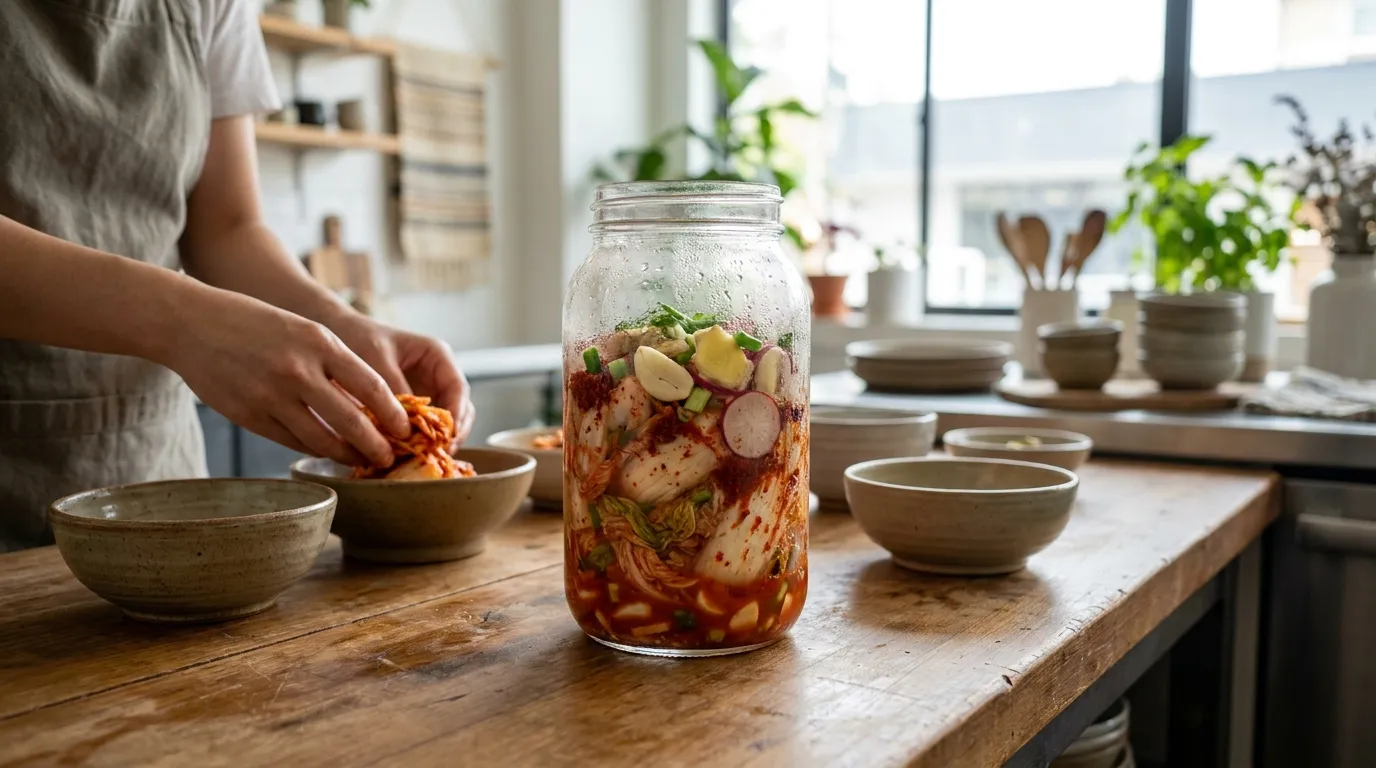
The heart of premium kimchi is fermentation. Real kimchi is not just chopped vegetables mixed with chili and vinegar. It keeps changing over time, and that is often a big reason people value it. Good small-batch kimchi is given time to ferment naturally, and that often brings more depth and a flavor that feels more balanced.
That process also matters for people who look for gut-friendly foods. A 2025 meta-analysis in Nutrition Reviews linked fermented kimchi consumption with 1.93 mg/dL lower fasting blood glucose, 28.9 mg/dL lower triglycerides, 3.48 mmHg lower systolic blood pressure, and 2.68 mmHg lower diastolic blood pressure. That does not make kimchi a cure-all, of course. But it helps explain why many people see it as more than a side dish, not just something extra on the plate.
Kimchi possesses prebiotic, probiotic, and postbiotic properties through various compounds originating from the raw ingredients of kimchi; the diverse LAB involved in kimchi fermentation; and various metabolites in a large quantity produced by the LAB.
— Study authors, Critical Reviews in Food Science and Nutrition
In simple terms, live fermentation creates a depth of flavor that shortcuts often cannot match. A premium jar usually tastes layered, with heat and tang alongside salt, a little sweetness, and savory depth all at once. For anyone wanting a clearer look at traditional style, this guide on authentic Korean kimchi covers the basics in a simple way without repeating them here.
Raw and unpasteurized kimchi feels more alive
One big reason small batch kimchi stands out is that it is often sold raw and kept cold in the fridge, instead of being made shelf-stable for a pantry. That helps it stay active. In a practical sense, it really does feel more alive. The texture usually feels fresher, and the flavor keeps changing in the fridge, which is often part of the appeal.
Pasteurized kimchi can still taste good, but heat changes the product. If someone is choosing premium kimchi for its living fermented character, raw usually makes a real difference. Recent research supports that difference too. In a 2024 Journal of Ethnic Foods study, uncooked kimchi increased fecal lactic acid bacteria in mice from 3.2 × 10^5 g^-1 to 2.00 × 10^7 g^-1.
Taken together, the findings in this study suggest the potential of kimchi both as a probiotic and postbiotic food with antioxidant and immunoenhancing properties.
— Study authors, Journal of Ethnic Foods
That is why artisan kimchi is usually refrigerated. It is active food, not something fixed or static. For shoppers who are curious about fermentation, that can feel exciting, and maybe a little unusual at first. They are not buying a product that stays exactly the same. They are buying something living.
A helpful way to think about it is this:
Signs a kimchi is likely raw and actively fermented
- It’s usually sold chilled, in the fridge section, instead of sitting on a dry shelf
- When you open it, a little bubbling can be a pretty good sign
- Over time, the flavor may change, which is often totally normal
- The label talks about fermentation rather than vinegar
- The texture tends to stay firm instead of turning mushy
For a lot of buyers, this is where premium kimchi starts to make sense. Taste is part of it, of course, but so are freshness, live fermentation, and that real character in the jar. That’s likely what helps it stand out.
Better ingredients create premium kimchi flavor and texture
A premium product is only as good as what goes into it, and with kimchi you can usually tell pretty fast. Napa cabbage, radish, garlic, ginger, scallions, sea salt, and gochugaru all matter, and it’s easy to notice when one of them is not up to par. If one ingredient is weak, the whole jar can taste dull pretty quickly.
Artisan kimchi makers usually pay more attention to whole vegetables, fresher aromatics, and fewer fillers, which often leads to a cleaner flavor. You notice the cabbage crunch right away and how it stays crisp in the jar. There’s also the warmth of garlic and ginger, along with the difference between real chili depth and simple heat, which is often easy to spot.
For home cooks, that really matters. Good kimchi is not just eaten on its own. It often becomes part of meals, showing up in pancakes, rice bowls, grilled cheese, noodles, and fried rice. When the base product is weak, the dish usually feels weak too, and that is hard to cover up.
Common mistakes in lower-grade kimchi include:
What often goes wrong in mass-market jars
- Sourness builds too fast from acidification
- Cabbage turns soft after rough handling
- Extra sugar hides weak fermentation
- The spice tastes generic instead of giving real gochugaru depth
- Preservatives or additives flatten the flavor
When comparing jars, one useful thing to notice is how clear the ingredients are and how the kimchi smells. Premium kimchi should usually smell fresh and savory, not harsh, and it should look rich in color rather than pale or washed out. You’ll also often find that the cabbage keeps some snap, which is usually a good sign.
For buyers in Barcelona, that matters even more because local fresh delivery can help keep that quality. In most cases, a fresh-to-order jar from Hellyn's Kitchen is more likely to keep that just-made care than a mass-distributed product that has spent a long time in storage and transport.
Small batches allow tighter control
It’s not the flashiest reason, but it’s probably the most useful in real life. Small batch kimchi is just easier to handle. The maker can keep a closer eye on salt balance, fermentation timing, vegetable condition, spice mix, and texture, and that’s a lot to manage at once. Those small details often make a real difference in a food like this.
In a huge industrial run, the main goal is consistency across thousands of jars. With artisan kimchi, though, the focus stays on the quality of each batch. That doesn’t mean every jar comes out exactly the same. In fact, small natural variations are often part of real fermented food, and that’s completely normal.
Because kimchi is sensitive, the maker can adjust things carefully as the batch changes. Even a few minor shifts can shape the final result, so you’ll usually notice when someone is paying close attention:
What small-batch control helps protect
- Crunch, not sogginess
- Balanced saltiness
- Heat that supports flavor instead of covering it up
- The right fermentation pace
- A fresh aroma, without overripe notes appearing too early
That also helps explain why many repeat buyers stick with local makers once they find one they trust. It feels more personal, and usually more reassuring too. The quality often seems carefully watched, instead of left to chance, which really matters here.
In Barcelona, that connection to local food matters a lot. People care about who made the food and how it was made, and you can often see that in the way they shop. It’s simple, but still important in everyday practice.
For people who buy often, batch care is also connected to planning. Practical things like order size matter, and this jar size guide can help you choose how much kimchi to order for home use.
Premium kimchi often respects tradition and still fits modern diets
One reason artisan kimchi stands out is that it can stay close to Korean methods while still fitting what people want now. A lot of shoppers today look for vegan kimchi, cleaner labels, and food that feels authentic but still works easily in everyday meals, which is likely a big part of the appeal. That balance often matters in real life, because tradition does not need to feel distant or hard to bring into daily routines.
Good premium kimchi does not have to be toned down to do that. A well-made vegan version can still have depth, heat, aroma, and real fermentation character. In a city like Barcelona, that feels especially relevant. Plant-based eating is common there, and many shoppers are curious about fermented foods while also wanting options that fit their lifestyle without losing bold flavor.
At the same time, premium kimchi usually avoids trying to please everyone by becoming bland. It keeps its identity, and that is part of what makes it special. What people get is food with roots, not a trend product trying to imitate fermented flavor. In many cases, it still tastes alive, sharp, and layered, which is often the whole point.
According to review authors in Critical Reviews in Food Science and Nutrition, health interest in kimchi is linked to the lactic acid bacteria involved in fermentation, along with their broader probiotic potential. That growing interest also likely helps explain how kimchi moved from a niche food into a regular grocery item.
Demand is growing, but not all kimchi grows in the same way
Kimchi is part of a much bigger food shift right now, and demand keeps rising around the world. In 2024, South Korea exported 47,100 tons of kimchi. That is a big number. By 2025, export value reached $164.4 million, with a 0.5% increase. Customs-based reporting also showed $137.39 million in the first 10 months alone, which shows how strong that demand has become.
| Kimchi trade metric | Value | Year |
|---|---|---|
| Exports from South Korea | 47,100 tons | 2024 |
| Total export value | $164.4 million | 2025 |
| First 10 months export value | $137.39 million | 2025 |
That growth makes it clear kimchi is not going anywhere. But when demand climbs, more shortcuts often appear too. More brands want in on the category, and not all of them are making true premium kimchi. So while the category is expanding, smart buyers usually need to look a little closer to see what they are actually getting.
So what should a smart buyer look for?
A simple buyer checklist
- When you can, choose refrigerated kimchi instead of shelf-stable. It’s usually the easiest first step.
- You’ll often find that small-batch makers or fresh-to-order production are a good sign.
- Check the ingredient list for whole foods you actually recognize, since those are usually easy to notice right away.
- Consider choosing a maker that explains the process clearly, in a way that makes sense without extra digging or guesswork. That often feels easier to trust.
- If you cook often, ask about repeat orders or bulk jars so you don’t run out.
And if delivery convenience matters, local buyers can also learn more about kimchi delivery in Barcelona and match quality with easy access.
The real value of premium kimchi in everyday life
Premium kimchi stands out because it gives more of what people usually want from kimchi: better flavor, better texture, stronger ingredient quality, and a fermentation process that feels closer to the original. That is really the heart of it. Small-batch kimchi is often raw, unpasteurized, and carefully watched as it ferments, which often makes a noticeable difference. Artisan kimchi also tends to follow Korean technique while still fitting modern preferences like vegan eating or fresh local delivery.
For health-conscious shoppers, that can mean a fermented staple that feels more useful in daily life. For home cooks, it gives them a stronger base ingredient in the kitchen, which is honestly very practical. And for expats and locals in Barcelona, it may mean finding kimchi that tastes closer to what they would get in Korea, without making it from scratch.
One useful next step is to read labels carefully. Chilled, naturally fermented jars are usually a better sign, and it helps to pay attention to ingredient quality and texture. You can also find clues in the cabbage crunch, the clarity of the brine, and whether the ingredients seem fresh. And if a local maker earns that trust, it often makes sense to stick with them long enough to notice how a good batch changes over time.
That is when premium kimchi stops feeling like a specialty extra and starts to feel like one of the smartest things to keep in the fridge alongside everyday staples. In many cases, a well-made jar from a neighborhood-focused Korean kimchi brand can do exactly that. So Hellyn's Kitchen is part of that growing local move toward fresher, more thoughtful fermented food.